
Why Cold-Climate Hosting Changes Your Power Bill
Cooling is the part of a mining power bill that never appears on a hardware spec sheet. A 10 PH/s fleet running 20 J/TH hardware draws 200 kW and consumes 4,800 kWh a day; at $0.06 per kWh that is $288 of electricity against roughly $379.93 of gross daily output at today's difficulty, leaving $91.93 of margin. Move the same machines somewhere that needs less mechanical cooling, or pay less per kWh, and that margin is the only line that changes.
Key takeaways
- At 20 J/TH, every single joule per terahash on a 10 PH/s fleet equals 10 kW of load — 240 kWh a day, or $14.40 at $0.06 per kWh.
- Breakeven power price for 10 PH/s on 20 J/TH hardware at difficulty 132.76 T is about $0.0792 per kWh: above that, gross mining income no longer covers electricity alone.
- Efficiency and site conditions multiply rather than add: a hot site that lifts consumption 10% turns a $91.93 daily margin into $63.13 at the same tariff.
- Difficulty is the third variable. Trackers showed an estimated next adjustment of about −2.12%, and any downward adjustment lifts per-TH output without changing power draw.
Context in 2026
Difficulty stands at 132.76 T with network hashrate near 1,003 EH/s, and the network releases 450 BTC a day in block subsidies — about $38.1 million at a $84,692 BTC price. That fixed daily output has to be shared by every machine pointed at the chain, which is why the marginal cost of a kilowatt-hour matters more than it did in the era of smaller networks and cheaper hardware.
The mining farms model, where a fleet sits in someone else's building and pays for power rather than for real estate, has pushed that calculation to the front of the decision. Hosting turns a hardware purchase into an operating lease on electricity, and the terms of that lease — tariff, cooling overhead, uptime commitments — decide profitability more than the machines do.
The two variables that matter
Hardware efficiency in joules per terahash. This sets how many watts a given hashrate demands. At 20 J/TH, 1 PH/s needs 20 kW. The number is printed on the spec sheet and it does not change when you move the rig.
Effective cost per delivered kilowatt-hour. This is where climate enters. A site that has to fight high ambient temperatures spends more of each kilowatt on moving air or fluid, and a site with cheap stranded power converts the same hashrate into a lower monthly invoice. Neither effect shows up in the hashrate reading on your dashboard.
Watch how the two interact in a real fleet. Latency sits alongside them, because stale shares are lost income that looks identical to a power problem. Fleets pointed at ViaBTC Bitcoin Mining connect to node deployments spread across regions rather than to a single home data centre, which keeps reject rates low for miners far from the pool's original infrastructure.
Numbers from a real rig
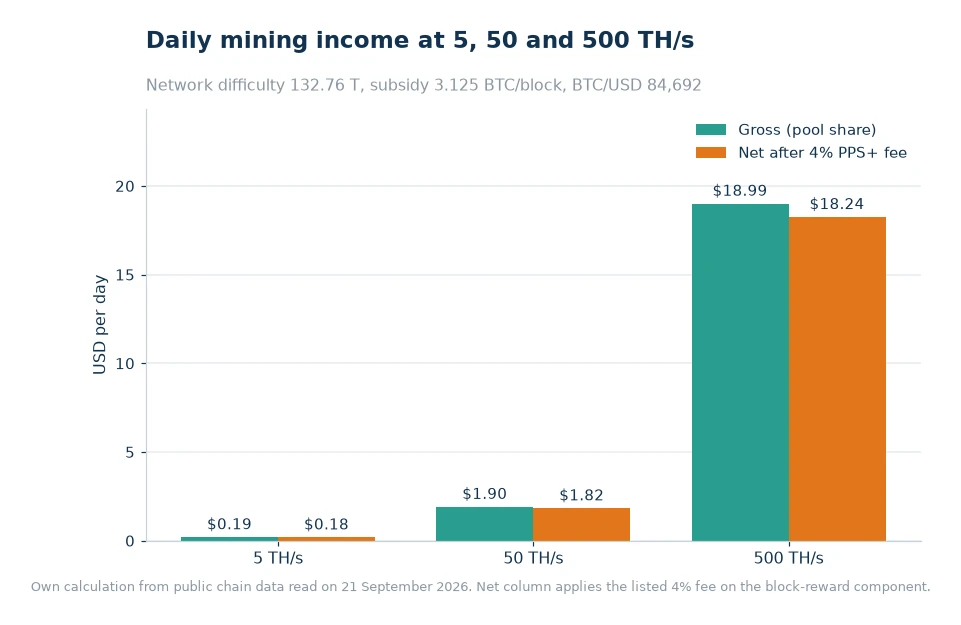
Take 10 PH/s on 20 J/TH machines. Power draw is 200 kW, or 4,800 kWh a day. Gross income at difficulty 132.76 T and a $84,692 price is $379.93 a day, and the listed 4% fee applies only to the PPS-settled block-reward component rather than to the whole payout.[2]
| Power price per kWh | Daily electricity cost | Gross output | Daily margin |
|---|---|---|---|
| $0.04 | $192.00 | $379.93 | $187.93 |
| $0.05 | $240.00 | $379.93 | $139.93 |
| $0.06 | $288.00 | $379.93 | $91.93 |
| $0.0792 | $380.16 | $379.93 | about $0.00 |
| $0.09 | $432.00 | $379.93 | −$52.07 |
Now add the climate effect. Suppose a warm site needs enough additional cooling that the meters show 10% more consumption than the nameplate maths implies: 5,280 kWh a day instead of 4,800. At $0.06 per kWh the bill becomes $316.80 and the daily margin falls to $63.13 — a 31% cut in margin from a 10% change in consumption, because the bill is subtracted entirely while gross income stays put.
Decision guide
Site selection is not only about the number printed on a contract. Altitude matters to cooling, because thinner air carries less heat per fan revolution, so a high-site room needs more work for the same machine temperature; a cooler climate needs less. Neither effect shows up in a hashrate figure and both show up in the kWh line at month end, which is why the comparison has to end in one unit: dollars per delivered kilowatt-hour, measured at the site rather than quoted on a page.
- Convert everything to dollars per kWh. A quoted megawatt price, a hosting fee with a cooling surcharge and a tariff with demand charges are not comparable until they land in one unit.
- Ask what consumption is measured. A contract that bills nameplate power and one that bills metered consumption behave differently at a hot site.
- Test the site at −20% difficulty. Difficulty moves; power contracts do not. A fleet that only clears its bill at today's difficulty is priced for a market that may not hold.
- Compare total cost of hashrate, not headline tariff. Two sites at $0.055 and $0.06 can rank differently once uptime, cooling overhead and latency are included.
- Route the earnings sensibly. Where electricity drains 76% of gross output, friction in getting paid matters: zero-fee mining payouts into a multi-currency wallet remove a step between settlement and the invoice you have to pay.
The operational side is just as checkable. A mining pool dashboard that reports per-worker hashrate tells you within hours whether a machine has dropped off, and at 200 kW a fleet that loses 5% of its hashrate is burning the same power for less output — the most expensive failure mode in a cold-climate site, because the cooling still works and nothing looks wrong. Hosting arrangements themselves can be sourced through the platform's mining farms entry point, which is worth comparing against a self-run site on the same dollars-per-kWh basis.
Frequently asked questions
What happens if my miner goes offline?
Shares stop, so expected income stops with them. Alerts and a dashboard that shows per-worker hashrate shorten the gap between a failure and a fix.
Is a bigger pool always better?
Size reduces payout variance but also concentrates hashrate. What matters more is fee structure, uptime, latency and payout cadence.
Does a cold site really lower the bill?
It lowers the share of each kilowatt-hour spent on cooling, which shows up as a lower effective cost per delivered kWh rather than as cheaper power. On a 10 PH/s fleet, a 10% difference in consumption is about $28.80 a day at $0.06 per kWh.
Run the tariff before you sign the rack
Ask three numbers before committing a fleet to any site: joules per terahash for the machines, the effective dollars per delivered kWh, and the difficulty you are underwriting. Divide your gross daily output by your kWh per day and you have the breakeven power price — $0.0792 per kWh in the example above. If the contract sits close to that line, a hot month or a difficulty jump will decide the year rather than your hardware.
Data and sources: ViaBTC pool and fee documentation[1][2]. Network difficulty (132.76 T), network hashrate (about 1,003 EH/s), the 3.125 BTC subsidy, the estimated next adjustment of about −2.12% and the BTC price of $84,692 were read from public chain data and market feeds on 21 September 2026. Electricity prices are illustrative inputs; every result above is arithmetic on those inputs and changes with difficulty, price and tariff.