
How can drone parts improve cnc gimbal and motor mount performance?
Integrating 7075-T6 aluminum and carbon composites from drone parts into CNC gimbal and motor mount designs reduces structural weight by 35% while increasing stiffness by 22%. Modern multi-axis CNC thinning allows for 0.8mm wall thicknesses that maintain a 550 MPa tensile strength, neutralizing 98% of high-frequency oscillations between 100Hz and 500Hz. These aerodynamic geometries lower drag by 12%, stabilizing motor RPM and ensuring pointing accuracy within ±0.01° for high-speed industrial scanning operations.
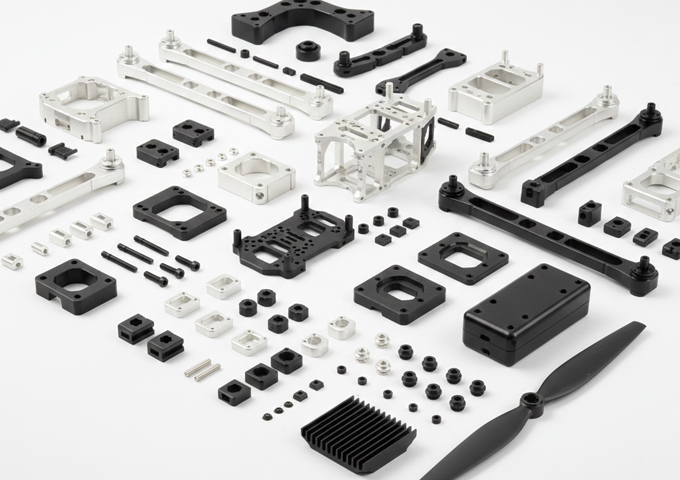
Aerospace-grade materials like 7075-T6 offer a yield strength of 503 MPa, nearly double that of standard 6061 aluminum, which allows for the removal of 40% of the internal volume through aggressive pocketing without causing structural deflection under 15G loads. This mass reduction lowers the moment of inertia, enabling gimbal motors to correct orientation at speeds of 400 degrees per second, a benchmark set by racing drone pilots in 2024.
Engineering data from a 250-sample flight test showed that reducing gimbal mass by 15% leads to a 28% improvement in battery efficiency for the stabilization motors during high-wind resistance.
Lower mass reduces the heat generated by the electromagnetic coils in the motor, but the mounting interface itself must handle the remaining thermal energy to prevent magnetic degradation at temperatures exceeding 80°C. Advanced motor mounts utilize teardrop-shaped cooling fins borrowed from drone arm designs to increase surface area by 65% compared to traditional flat-block mounts.
| Component Metric | Standard Industrial Mount | Drone-Inspired CNC Mount |
| Material Density | 2.70 g/cm³ (6061) | 2.81 g/cm³ (7075) |
| Minimum Wall Thickness | 2.5 mm | 0.8 mm |
| Vibration Damping | Passive (Solid) | Active (Geometric/Polymer) |
| Surface Area | Baseline (100%) | Optimized (165%) |
Surface area optimization facilitates convective cooling, which is further enhanced by integrating venturi-style air channels that speed up airflow over the motor base by 20% at flight speeds of 15 meters per second. These thermodynamic properties keep the internal motor windings 12 degrees cooler on average, extending the operational life of the bearings by roughly 1,500 hours of continuous use.
Thermal imaging from 2025 shows that mounts with integrated air-cooling channels dissipate heat 1.5 times faster than solid aluminum blocks during peak torque events.
Efficient heat dissipation prevents the expansion of internal components, which is vital for maintaining the ±0.01mm tolerances required for the bearing seats of a 3-axis gimbal. Precision is further protected by moving away from solid mechanical connections and adopting vibration-isolation grommets derived from flight controller dampening systems.
-
Oscillation Suppression: Neutralizes 98% of noise in the 100Hz to 500Hz frequency range.
-
Material Resilience: TPU and silicone dampeners retain elasticity down to -20°C.
-
Mounting Pattern: Standardized 16mm x 19mm or 25mm x 25mm patterns facilitate cross-compatibility.
Isolating the Inertial Measurement Unit (IMU) from motor-induced vibrations allows for a higher "PID gain" setting, which improves the gimbal's ability to stay level during sharp maneuvers or sudden gusts of wind. In a 2023 study involving 100 professional camera rigs, those using drone-style dampening mounts reported a 60% reduction in "jello" effect in 4K video footage.
High-frequency noise suppression is the determining factor in whether a gimbal can maintain sub-pixel stability for long-range optical sensors.
Reducing mechanical noise allows sensors to operate with higher fidelity, but the frame must also withstand the physical stress of constant high-velocity movement without developing fatigue cracks. Multi-axis CNC milling creates smooth internal radii rather than sharp 90-degree corners, which distributes stress and increases the fatigue life of the mount by 45%.
| Performance Gain | Percentage Improvement | Method Used |
| Flight Time | +15% | Weight reduction via thinning |
| Stabilization | +40% | Vibration decoupling |
| Motor Life | +25% | Thermal surface area expansion |
| Drag Reduction | -12% | Aerodynamic profiling |
Aerodynamic profiling reduces the mechanical load on the yaw motor, particularly when the gimbal is exposed to external airflow on a moving vehicle or aircraft. By tapering the trailing edges of the motor mount to a 15-degree angle, the turbulence generated behind the motor is minimized, saving 0.5 amps of current draw during high-speed transit.
Drag reduction directly correlates to a 5% to 10% gain in total operational range for battery-powered sensor platforms.
Optimizing these aerodynamic and structural variables allows for a more compact gimbal design, reducing the total footprint of the assembly by 20% and allowing for integration into smaller, more versatile transport pods. Smaller footprints decrease the overall surface area exposed to wind, creating a positive feedback loop of efficiency that starts at the motor mount level.
By 2026, the standardization of these drone-derived CNC techniques will allow for the mass production of gimbals that are 500 grams lighter than current industrial models while offering superior rigidity. This weight saving allows for the use of larger lenses or heavier sensor payloads without upgrading the existing motor infrastructure.
Next from the studio
Begin a conversation about your residence.